



Ship Code. Not Malware. SafeDep Launches GitHub App for Malicious Package Protection
On this page
Malicious Package in the Wild
The recent supply chain attack targeting the npm ecosystem, such as the Shai-Hulud and the S1ngularity campaign, has raised serious concerns among the developer and security engineering community. Detecting malicious code in open source packages is a complex problem, and it requires a multi-layered approach. We have been doing this for a while leveraging:
While we handle the complexity, we have always strived to provide the simplest and minimally intrusive solution to protect developers from malicious packages. So we launched SafeDep GitHub App to make it ridiculously simple to protect your code repositories from malicious packages.
Installation is simple and zero configuration - Install Now
Zero Configuration Malicious Package Protection
How To Get Started?
- Install the SafeDep GitHub App
- Wait for the next pull request to be scanned
- Stay protected from malicious packages
That’s it! It is really that simple. Here is how it looks like in action:
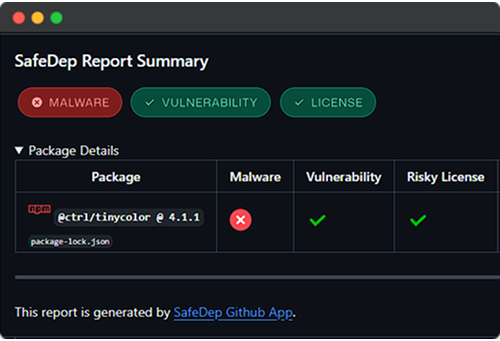
How it works?
SafeDep scans all open source packages released to supported registries such as npm, PyPI, RubyGems, Cargo and more. SafeDep applies static, dynamic and agentic analysis to detect malicious packages. While these packages are removed from the registries, SafeDep tools leverage this threat intelligence to protect code repositories from malicious packages.
What are the benefits?
- Zero Configuration: Install the app with zero configuration
- Real-time Protection: Scans every pull request for malicious packages
- Multi-Ecosystem: Supports npm, pnpm, yarn, and more
- Multi-Language: Supports JavaScript, TypeScript, Python, and more
- Multi-Platform: Supports Windows, Linux, and macOS
Documentation and Support
- GitHub App Documentation: SafeDep GitHub App
- Community support: https://docs.safedep.io/community
- npm
- oss
- malware
- supply-chain
Author

SafeDep Team
safedep.io
Share
The Latest from SafeDep blogs
Follow for the latest updates and insights on open source security & engineering
DirtyBlanket: Fake Express Packages on npm Spread a Linux Worm
Nine fake Express and React packages on npm run a Linux worm at install time. It installs a Tor backdoor and spreads through SSH, AUR packages, and npm tokens.

Mini Shai-Hulud Is Still Infecting GitHub Repositories
The May 2026 Mini Shai-Hulud worm is still infecting new GitHub repositories. Hijacked actions-cool/issues-helper tags planted Claude Code and VS Code hooks in six popular repositories between 20 and...

Detecting Compromised AI Coding Agents with Jev and Gryph
I checked every action of my own Claude Code agent against a profile of how I work and a set of org policies, using Jev. It caught 14 of 14 attacks for $0.15 per 1,000 events.
MemTensor npm and PyPI Packages Hit by a Go Worm
An attacker used a Go worm to steal CI publish tokens from MemTensor and ship malicious MemOS packages to npm and PyPI. See how it works, with code and indicators of compromise.


Ship Code.
Not Malware.
Start free with open source tools on your machine. Scale to a unified platform for your organization.
