



Multiple Malicious Python Packages Targeting Bittensor Crypto Developers
On this page
TL;DR
Multiple malicious Python packages targeting crypto developers and their applications were discovered on PyPI. The packages were used to steal funds by executing a stealthy staking operation. In this specific case, the attackers hooked a legitimate staking function to redirect the funds to their own wallet. The attack leveraged typosquatting to target the popular bittensor package.
Following malicious packages were disclosed by GitLab Vulnerability Research Team:
bitensor@9.9.4bittenso-cli@9.9.4qbittensor@9.9.4bitensor@9.9.5bittenso@9.9.5
How SafeDep can protect developers?
SafeDep open source tools especially vet and pmg can help protect developers from malicious packages and other open source software supply chain attacks.
Our automated systems flagged the packages as suspicious due to multiple signals, including identifying the malicious code and intention in typosquatting packages. See example
- Hardcoded destination wallet address
5FjgkuPzAQHax3hXsSkNtue8E7moEYjTgrDDGxBvCzxc1nqR - Forced
transfer_all=Trueindicating operations without user consent
| Malicious Package | SafeDep Analysis | Flagged At |
|---|---|---|
bitensor@9.9.4 | Link | 8/6/2025, 2:53:48 AM |
bittenso-cli@9.9.4 | Link | 8/6/2025, 2:59:52 AM |
qbittensor@9.9.4 | Link | 8/6/2025, 3:03:45 AM |
bitensor@9.9.5 | Link | 8/6/2025, 3:16:03 AM |
bittenso@9.9.5 | Link | 8/6/2025, 3:17:10 AM |
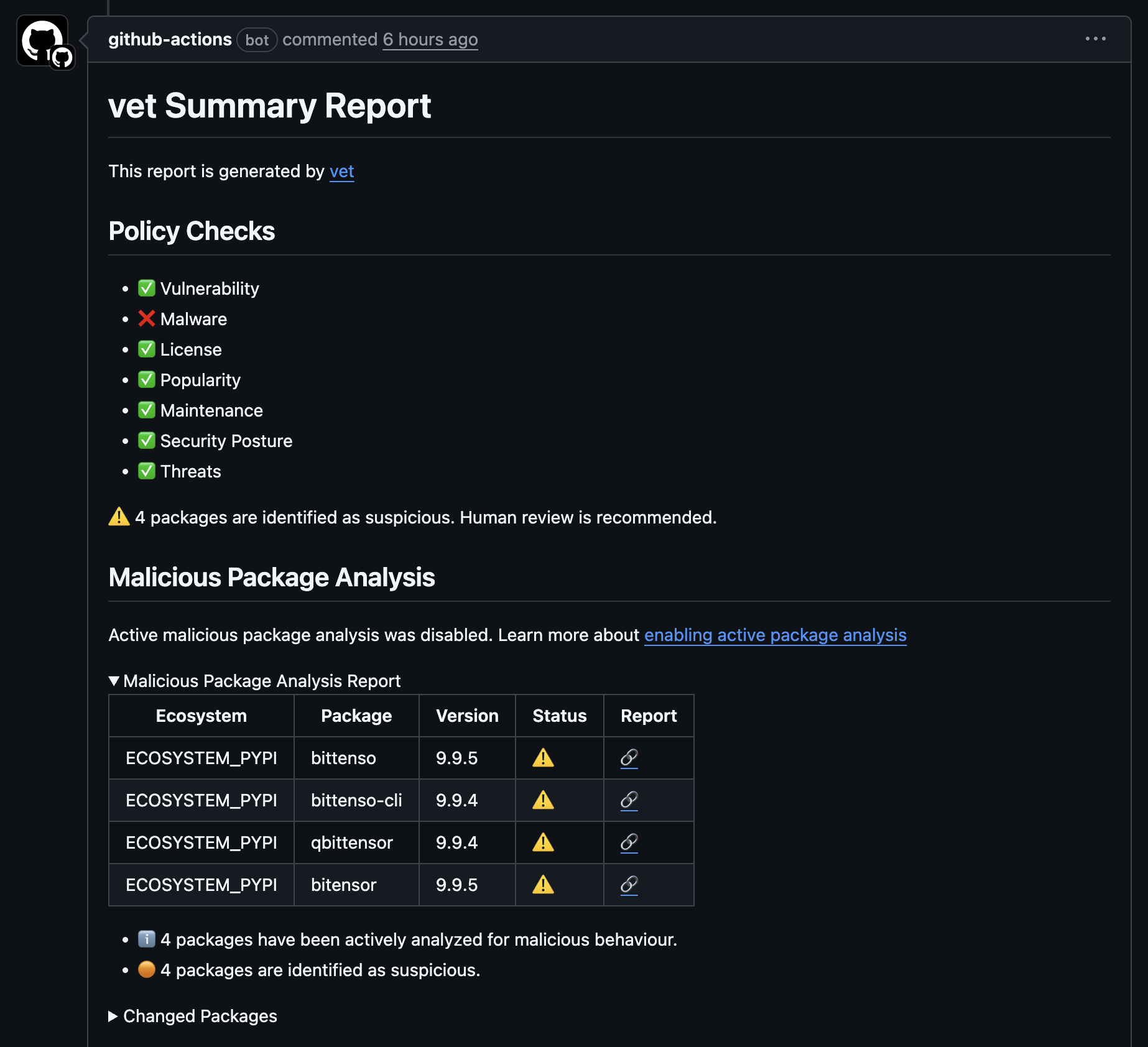
SafeDep vet alerted users in CI/CD pipelines when trying to add any of the compromised package through a PR.
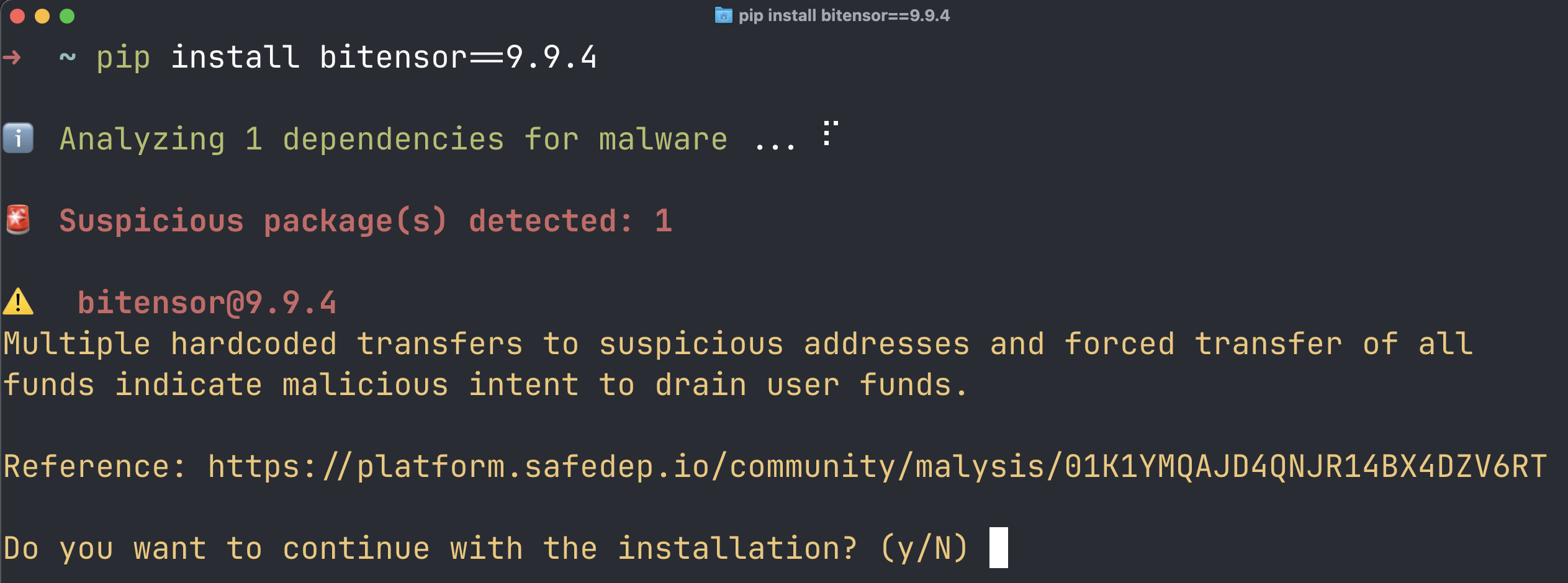
SafeDep pmg will alert developers when trying to install any of the compromised package.
How to protect your project?
At SafeDep, we believe code is the source of truth. We perform code analysis to detect vulnerabilities and malicious code in open source packages. If that is not feasible, general security best practices can be used to protect against common open source software supply chain attacks.
- Always vet open source packages for vulnerabilities and malicious code before use
- Ensure branch protection rules require code review before merging
- Establish trust on packages through its popularity, community or code review
- Avoid using most recently released package versions
- Prefer using open source packages only from trusted sources
SafeDep vet seamlessly integrates with your CI/CD pipeline and alerts you when trying to add any of the compromised package through a PR. SafeDep pmg will alert developers when trying to install any of the compromised package.
References
- pypi
- oss
- malware
- crypto
Author

SafeDep Team
safedep.io
Share
The Latest from SafeDep blogs
Follow for the latest updates and insights on open source security & engineering

PolinRider Switches to Ethereum C2 in 30+ Repositories
A malicious pull request against oxc led SafeDep to a larger campaign. The PolinRider loader family now reads its C2 servers from Ethereum transactions. SafeDep confirmed 35 GitHub repositories that...

Detecting Compromised AI Coding Agents with Jev and Gryph
I checked every action of my own Claude Code agent against a profile of how I work and a set of org policies, using Jev. It caught 14 of 14 attacks for $0.15 per 1,000 events.
DirtyBlanket: Fake Express Packages on npm Spread a Linux Worm
Nine fake Express and React packages on npm run a Linux worm at install time. It installs a Tor backdoor and spreads through SSH, AUR packages, and npm tokens.

Mini Shai-Hulud Is Still Infecting GitHub Repositories
The May 2026 Mini Shai-Hulud worm is still infecting new GitHub repositories. Hijacked actions-cool/issues-helper tags planted Claude Code and VS Code hooks in six popular repositories between 20 and...


Ship Code.
Not Malware.
Start free with open source tools on your machine. Scale to a unified platform for your organization.
