



Curious Case of Embedded Executable in a Newly Introduced Transitive Dependency
On this page
TL;DR
This is a story of a new open source package introduced as a transitive dependency during a regular dependency upgrade. The package was flagged as suspicious due to an embedded executable. However, manual analysis confirmed that it is not malicious. This incident highlights the fact that significant volume of code, in any software, is introduced through the open source software supply chain, especially through transitive dependencies that are outside practical control of downstream software consumers. The question remains:
How to trust code from open sources that are a major part of any software
Discovery
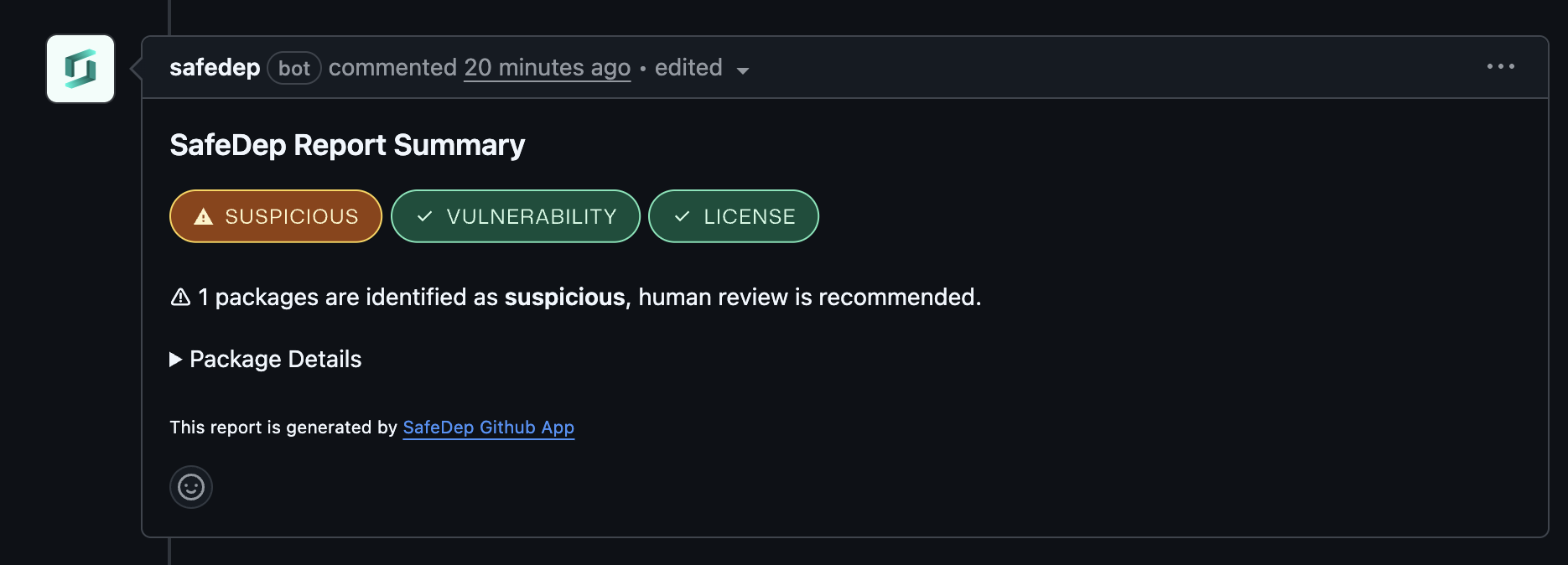
At SafeDep we dogfood our own products. More recently, the GitHub App for protecting against malicious open source packages. While performing a regular dependency upgrade chore, we came across a very interesting real life gotcha in a pull request xbom/51. The GitHub App flagged a suspicious package.
Analysis
On inspecting further, github.com/clipperhouse/stringish @ v0.1.1 Go module was flagged as suspicious. The pull request in question was raised with following intentional changes:
- Go dependency upgrades using
go get -u Dockerfilebase image update for Go 1.25.2 builder image
Note: The pull request in question is available at xbom/51
Surely no new dependency was intentionally added. When an unknown dependency was flagged as suspicious, we almost certainly assumed it to be in a transitive dependency. The immediate response was to identify the package relationships through which this particular Go module was introduced.
go mod why github.com/clipperhouse/stringishThe output shows the path in the dependency graph through which github.com/clipperhouse/stringish
was introduced
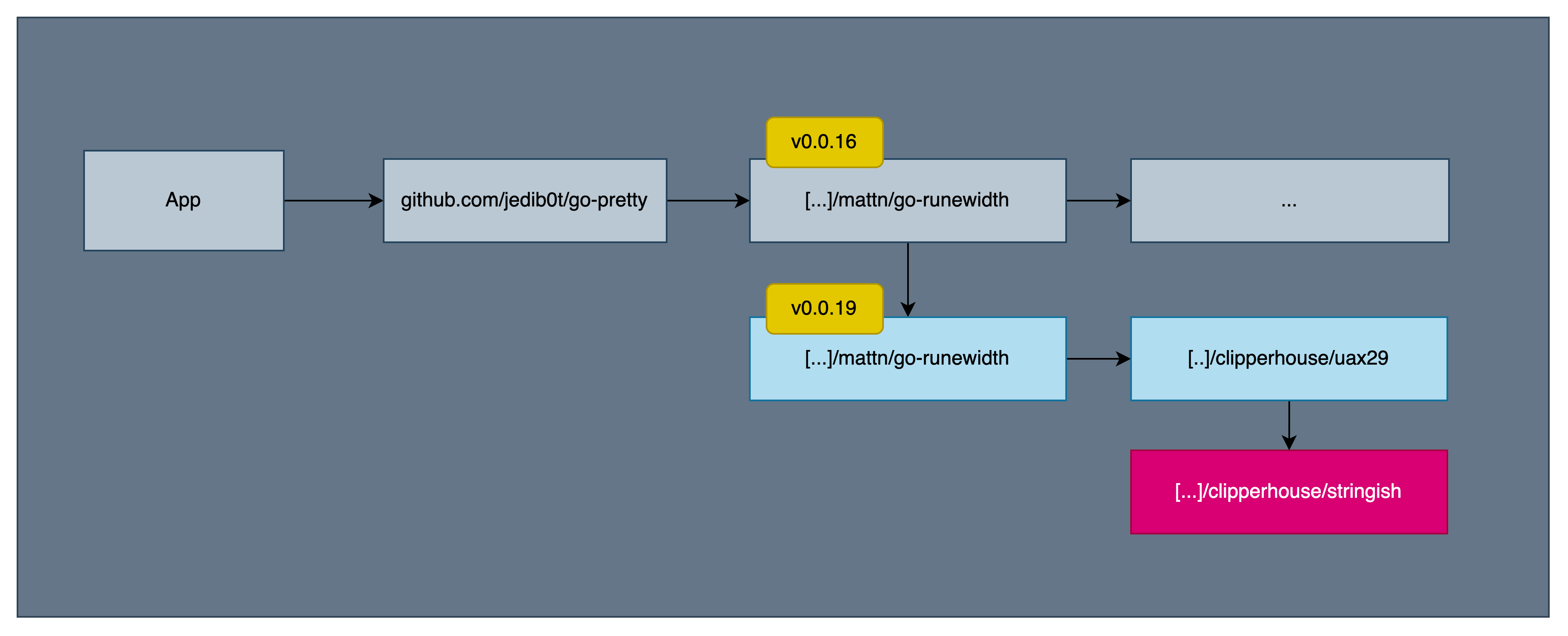
github.com/safedep/xbom/pkg/reportergithub.com/jedib0t/go-pretty/v6/textgithub.com/mattn/go-runewidthgithub.com/clipperhouse/uax29/v2/graphemesgithub.com/clipperhouse/stringishA quick git diff confirmed that the last 2 dependencies are newly introduced:
git diff main | grep -i clipperhouse+ github.com/clipperhouse/stringish v0.1.1 // indirect+ github.com/clipperhouse/uax29/v2 v2.3.0 // indirectBut the version of github.com/mattn/go-runewidth was updated
- github.com/mattn/go-runewidth v0.0.16 // indirect+ github.com/mattn/go-runewidth v0.0.19 // indirectAt this point, it was pretty clear that the dependency change was introduced between v0.0.16 and v0.0.19 of
github.com/mattn/go-runewidth package. We confirmed this:
git clone https://github.com/mattn/go-runewidth /tmp/go-runewidth && \cd /tmp/go-runewidth && \git diff v0.0.16...v0.0.19 -- go.moddiff --git a/go.mod b/go.modindex 62dba1b..7dae1f3 100644--- a/go.mod+++ b/go.mod@@ -1,5 +1,5 @@ module github.com/mattn/go-runewidth
-go 1.9+go 1.20
-require github.com/rivo/uniseg v0.2.0+require github.com/clipperhouse/uax29/v2 v2.2.0github.com/rivo/uniseg, a project with 600+ stars and 8 contributors
was replaced with github.com/clipperhouse/uax29 which is built and maintained by an individual developer. github.com/clipperhouse/uax29@v2 in turn depends on github.com/clipperhouse/stringish, a package that was published only two weeks back.
While single developer projects are not a vulnerability in itself, but recently published package with very few published versions included in transitive dependency matches common attacker TTPs that we have seen in various open source software supply chain attacks in the recent past.
The following diagram describe the path through which the suspicious package was introduced.
Why Flagged?
The automated analysis report is available here. The key reason due to which the package was flagged as suspicious:
- Recently released package with fewer versions
- Embedded executable
github.com/clipperhouse/stringish@v0.1.1/utf8/utf8.test
stringish/utf8 on HEAD (068e024) via 🐹 v1.24.3❯ file utf8.testutf8.test: Mach-O 64-bit executable arm64Is it a malware?
No. github.com/clipperhouse/stringish@v0.1.1 is not a malware. We confirm this in following ways:
- Using xbom to scan for program capabilities
- Manual source code review
Firstly, xbom, a tool that checks for code capabilities (such as process execution) through static code analysis,
did not find any risky code capabilities. Manual analysis also did not find any reference to the utf8.test file.
In fact, there was no reference found for the utf8.test file at all due to which stringish/issues/1 was raised to discuss possibility of removing binary executable from Go module repository.
Conclusion
This is not a case of malicious package. But this incident resembles multiple malicious packages that we have analysed in the past such as llm-oracle malicious npm package. In fact, introducing unused binary packages or executables resembles the maintainer led attack pattern in xz incident.
While there is no evidence of malicious intent in this specific case, the fact remains, open source code is adopted with implicit trust today. This behavior is exploited by introducing malicious code through the open source software supply chain. While code analysis remains one of the reliable methods of protecting against such attacks, such analysis has its limits. Software development teams need to be aware of this risk and take appropriate measures to protect themselves.
Reference
- xbom
- golang
- sca
Author

SafeDep Team
safedep.io
Share
The Latest from SafeDep blogs
Follow for the latest updates and insights on open source security & engineering
DirtyBlanket: Fake Express Packages on npm Spread a Linux Worm
Nine fake Express and React packages on npm run a Linux worm at install time. It installs a Tor backdoor and spreads through SSH, AUR packages, and npm tokens.

Mini Shai-Hulud Is Still Infecting GitHub Repositories
The May 2026 Mini Shai-Hulud worm is still infecting new GitHub repositories. Hijacked actions-cool/issues-helper tags planted Claude Code and VS Code hooks in six popular repositories between 20 and...

Detecting Compromised AI Coding Agents with Jev and Gryph
I checked every action of my own Claude Code agent against a profile of how I work and a set of org policies, using Jev. It caught 14 of 14 attacks for $0.15 per 1,000 events.
MemTensor npm and PyPI Packages Hit by a Go Worm
An attacker used a Go worm to steal CI publish tokens from MemTensor and ship malicious MemOS packages to npm and PyPI. See how it works, with code and indicators of compromise.


Ship Code.
Not Malware.
Start free with open source tools on your machine. Scale to a unified platform for your organization.
